THE WORD ON POP CULTURE
  • Home
  • Movies
  • TV
  • Music
  • Sports
  • Pop Culture History
  • Pop Culture Connections Archives
  • Shop

Bohemian Rhapsody

11/11/2018

0 Comments

 
by Philip Price
Picture
Director: Bryan Singer
Cast: Rami Malek, Lucy Boynton, Gwilym Lee
Rated: PG-13
Runtime: 2 hours & 14 minutes
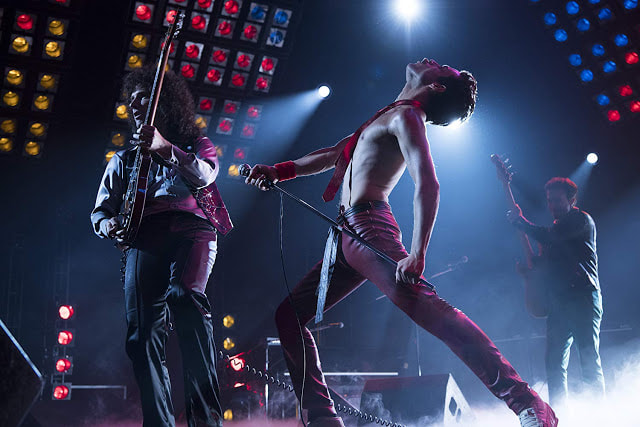
It's not what you say, it's how you say it. It is this common expression that the rather simple and safe interpretation of the story of Queen that “Bohemian Rhapsody” tells might have benefited from remembering. In a nutshell, Bryan Singer and Dexter Fletcher's biopic covers the early years of Brian May (Gwilym Lee) and Roger Taylor's (Ben Hardy) band just before it recruits lead singer Freddie Mercury (Rami Malek) and becomes known as Queen up through their 1985 performance at Live Aid that is considered one of the greatest performances in rock history. This is all well and good and makes sense for the arc of the band during its peak time of popularity, but within this arc Anthony McCarten's (“The Theory of Everything”) screenplay never digs deep enough for audiences to really catch a glimpse of what actually defined Queen as a group or what made them, as a unit, so willing and trusting in one another to the extent they'd each be willing to bet everything on the titular song being a hit despite the fact a senior A&R exec with more experience than all of the members of Queen combined doesn't believe it to be. Of course, this is where one would retaliate with the, "fortune favors the bold," phrase that is also used in the movie and I'm not saying the members of Queen were wrong or stupid for doing this-obviously they weren't-or that the A&R exec was right-obviously he wasn't-but what I am saying is that “Bohemian Rhapsody,” the film, never gives the audience reason to trust in the word of Mercury, May, Taylor and bassist John Deacon (Joe Mazzello) over this more experienced character outside of the fact it presumes the audience knows the story and music of Queen well enough to just go with it. And that's exactly what “Bohemian Rhapsody” does the majority of the time: it simply asks the audience to "go with it" as it rotates through the band's greatest hits and gives the expected beats of their meteoric rise, the inner tensions and turmoil that come with fame and notoriety, the distance that naturally grows between Mercury and the rest of his band mates, and their eventual reconciliation that leads to a triumphant return. It's all here, but the real disappointment with the story of Queen in particular is that it has so many unique variables and perspectives that this predictable pattern of the music biopic could have been used purely as a template while the actual style and substance of what was being communicated could have been fulfilled in more creative and effective ways. Instead, “Bohemian Rhapsody” is unapologetically "fine" and will largely be remembered for finding an excuse to play so many great songs on theater quality sound systems.

Of course, what was always going to be the biggest hurdle for a biopic about Queen and more specifically, about Mercury, was that of finding an actor who might portray the iconic rock deity without the performance feeling like a pale imitation of the idea each of us have of Freddie Mercury in our minds. The stories of Mercury's debauchery are as legendary as his vocal range and while I would have loved to have seen not only the type of performance Sacha Baron Cohen might have delivered in the role, but the undoubtedly R-rated film within which he would have delivered it what Rami Malek, star of television's “Mr. Robot,” has done with this opportunity is as good as can be expected even if, in certain instances, his wholly invested and deeply researched performance does in fact come off as something of a pale comparison. This is especially true when it comes to moments that Malek is supposed to spontaneously burst into song putting Mercury's pipes front and center and it becoming all the more evident how much Malek is not only lip-synching, but that no one else on the planet could imitate Mercury's voice in a way that would come off as even the least bit convincing. Jamie Foxx had strong enough chops and an abundance of swagger to the point he could pull off Ray Charles with real conviction and Joaquin Phoenix carried the right amount of mystery and pain behind his eyes to portray the Man in Black while learning to play guitar and sing just well enough to properly persuade the audience they were watching what could have very easily been a young Johnny Cash. With Mercury, things are different not only because no one else-even in the music business-could sing like Mercury, but because he carried such a distinct look that has become so singularly exclusive to the legend that continues to be built and grow around him.

All things considered then, it is a wonder any actor might be able to pull off convincing an audience they are actually watching Freddie Mercury for any sustained amount of time, but there are moments throughout “Bohemian Rhapsody” where Malek is able provide glimpses of what the performer might have been like in the "in-between" moments when Mercury was neither performing, writing music, or consorting with any number of random house guests that wanted to party as much as he reportedly did. Of course, it is in these instances that the film also chooses to paint Mercury as an unsuspecting player in his own life that stumbles into his homosexuality and is preyed upon by a manager that is either out to take advantage of the singer by any means necessary or is the most relentless of romantic pursuers despite being shot down any number of times. This is in reference to Allen Leech's Paul Prenter who, in real life, served as Mercury's manager for over a decade and coincidentally died the same year as Mercury (1991) from complications from AIDS. While there seems to have undoubtedly been some tension between Mercury and Prenter from time to time as well as between Prenter and the rest of the members of Queen the relationship the film largely focuses on in regards to Mercury is one that might surprise most given it would seem Mercury's sexuality was a foregone conclusion given his public persona, but Mercury was in fact engaged to and-as the movie tells it-genuinely in love with Mary Austin (Lucy Boynton). It is in the portrayal of Mercury and Austin's relationship as well as the eventual handling of Mercury's gay relationships that things not only feel rather sanitized in order to paint the singer in the most flattering of lights, but that the restrained approach is also taken in order to avoid garnering more personal interactions within these aforementioned "in-between moments". Yes, “Bohemian Rhapsody” is about the whole of Queen, but even the movie doesn't try to kid itself into believing Mercury wasn't the real draw and while getting deeper than surface-level about Mercury's private life would have immediately elevated this to a different level so as to better understand his choices as a performer in digging a little deeper not just on a singular level, but in regards to the band as a group of talented musicians who've crafted some of the biggest anthems in rock history wouldn't have been too shabby either.

Malek has a line in the film when discussing what it's like to be able to feel like the exact version of the person he always imagined himself to be when he's either on stage controlling an arena of thousands or in the company of Austin, but even something as insightful as this is so fleeting so as to get to the next plot point in the series of necessary story beats that must be hit in order to qualify as a feature that this kernel of an idea or feeling that is offered is abandoned almost as quickly as it was brought up-never to be explored further. Austin was something of a safe haven for Mercury when he had no one else to turn to and when the drinks and the drugs began to taste stale and both Boynton and Malek find a lovely sort of balance between the two characters so as to effectively convey a love for one another that has to withstand a harsh truth and thus transcend traditional relationships in a time when exploration was denounced and conformity was expected. It is in this aspect that ‘Bohemian’ finds its one true surprise in terms of narrative direction, but while the narrative plays it rather safe that isn't to say what the film does cover in terms of the band coming together and making music isn't at least entertaining as the sequence in which the band defiantly proposes the kind of record they'll produce as a follow-up to their self-titled album that featured their first commercial hit through to the composition of the title track isn't fairly exhilarating. It is in this instance that “Bohemian Rhapsody” almost too perfectly realizes how much of a double-edged sword it is. There is enough runtime to divulge the different elements of this six-minute opus and the lengths Mercury went to in the recording sessions to get the song as close to what he had in his head as possible, but we get none of the inspiration for the lyrics or the guitar solos. Hell, we don't even get that clichéd and hackneyed moment of one of the members of the band realizing what the name of the song should be through obvious inspiration. Naturally, one understands it's difficult to cram 15 or so years' worth of events into a two-hour movie and make it a coherent story with a beginning, middle, and end, but there is a specificity lacking in “Bohemian Rhapsody” that might have otherwise offered both a more sincere and thus a more moving portrait of this man and this band.

Furthermore, if the film was going to try and veer more towards a biopic of Queen as a band rather than emphasize the life of Mercury it might have done more to highlight the fact Queen wasn't made up of individuals who were inclined to fall into the trappings of the rock and roll lifestyle. Brian May earned a Bachelor of Science degree in Physics while Roger Taylor studied dentistry before the whole music gig took off for each of them. Even the last member to join the original line-up, John Deacon, was studying engineering when he was recruited by May, Taylor, and Mercury to be a part of Queen. In all honesty, Deacon might be the most unheralded of the group who in all actuality offered the most given six of the many songs he wrote for the band were released as singles including "You're My Best Friend," "I Want to Break Free" and "Another One Bites the Dust." The film also highlights the fact May penned the biggest stadium anthem of all time and makes a point to poke good fun at Taylor for being the weakest songwriter among the group. That this group of guys, outside of Mercury, were more or less average Joe's with wives and children who just so happened to possesses some exceptional creative talent and be a part of one of the biggest rock bands of all time is a unique approach all its own, but while the majority of McCarten's narrative understandably focuses on the life and times of Mercury it would have been nice had the film at least staged the lead singers moments with his band in a more credible fashion than what is delivered. Outside of the admittedly chill-inducing Live Aid re-creation each of the performance sequences look as if they were shot in the same venue with different costumes and clarifying text sent across the screen to state where in the world Queen was touring. Ultimately, while largely serviceable, “Bohemian Rhapsody” takes the undefinable nature of Freddie Mercury himself and conveys it through this box of convenience, of expectation, and of a certain categorization that would have undoubtedly made the real Mercury scoff for he was anything but definable. It only seems appropriate “Bohemian Rhapsody” might have transcended the genre of musical biopics in the same way its subject transcended every aspect of life, but hey-"Radio Gaga" is super legit, right?
0 Comments


Leave a Reply.

    Archives

    May 2026
    April 2026
    March 2026
    February 2026
    January 2026
    December 2025
    November 2025
    October 2025
    September 2025
    August 2025
    July 2025
    June 2025
    May 2025
    April 2025
    March 2025
    February 2025
    January 2025
    December 2024
    November 2024
    October 2024
    September 2024
    August 2024
    July 2024
    June 2024
    May 2024
    April 2024
    March 2024
    February 2024
    January 2024
    December 2023
    November 2023
    October 2023
    September 2023
    August 2023
    July 2023
    June 2023
    May 2023
    April 2023
    March 2023
    February 2023
    January 2023
    December 2022
    November 2022
    October 2022
    September 2022
    August 2022
    July 2022
    June 2022
    March 2022
    February 2022
    January 2022
    December 2021
    November 2021
    October 2021
    September 2021
    August 2021
    July 2021
    June 2021
    April 2021
    March 2021
    February 2021
    January 2021
    December 2020
    November 2020
    October 2020
    September 2020
    August 2020
    July 2020
    June 2020
    May 2020
    April 2020
    March 2020
    February 2020
    January 2020
    December 2019
    November 2019
    October 2019
    September 2019
    August 2019
    July 2019
    June 2019
    May 2019
    April 2019
    March 2019
    February 2019
    January 2019
    December 2018
    November 2018
    October 2018
    September 2018
    August 2018
    July 2018
    June 2018
    May 2018
    April 2018
    March 2018
    February 2018
    January 2018
    December 2017
    November 2017
    October 2017
    September 2017
    August 2017
    July 2017
    June 2017
    May 2017
    April 2017
    March 2017
    February 2017
    January 2017
    December 2016
    November 2016
    October 2016
    September 2016
    August 2016
    July 2016
    June 2016
    May 2016
    April 2016
    March 2016
    February 2016
    January 2016
    December 2015
    November 2015
    October 2015
    September 2015
    August 2015
    July 2015
    June 2015
    May 2015
    April 2015
    March 2015
    February 2015
    January 2015
    December 2014
    August 2014
    July 2014
    June 2014
    May 2014
    April 2014
    March 2014
    February 2014
    January 2014
    October 2013
    August 2013
    December 2012
    September 2012
    August 2012
    July 2012
    April 2012
    March 2012
    February 2012
    January 2012


​
Proudly powered by Weebly
  • Home
  • Movies
  • TV
  • Music
  • Sports
  • Pop Culture History
  • Pop Culture Connections Archives
  • Shop