 by Philip Price
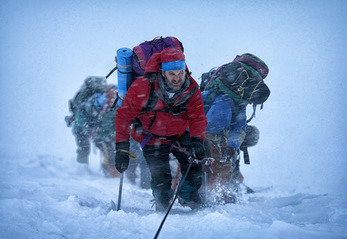
Like its titular mountain, “Everest” the film is a vast beast of an adventure. More than anything, director Baltasar Kormákur gives the film a strong foundation on which to stand and a sense of adventure going forward that is more than enough to make up for what can sometimes feel like a slim narrative. That is, of course, until the film reaches its last half hour in which it feels like it has to rush to resolve every plot strand it has set up for its large ensemble cast. That said, the film is more than a solid venture into one of the most dangerous places on earth that people dare to go which brings us to the real heart of the film. Without the crux of why each of these individuals wanted or were willing to risk their lives for a reward that, for some, could be viewed as senseless is what provides the anchor of the audience’s investment. There are plenty of ways in which Kormákur could have chosen to approach this set-up that was primed perfectly for little more than a tense, action spectacle, but at its heart this is a human story. And so, the fact Kormákur and writers William Nicholson and Simon Beaufoy have essentially made both a rousing testament to the human spirit and a devastatingly brutal film that delivers the man versus nature psychology to an unflinching degree is admirable. In many ways, “Everest” doesn't purport to be anything more than a straightforward documentation of this true story that occurred in 1996 when a team of thrill-seekers attempted to scale Mt. Everest, but it can't help but to be about more given the grand themes that life naturally brings down upon us when we're stranded in desperate situations and have nothing else to turn to but our thoughts and memories. Kormákur largely tackles the positive aspects of this kind of adventure and way of thinking in the first half of the film before everything goes south and the darker side of these risks are exposed. The film begins in late March of 1996 when Rob Hall (Jason Clarke), head of Adventure Consultants was getting ready to lead an expedition to the peak of Mt. Everest. Leaving behind a pregnant wife, Jan (Keira Knightly), Hall is thrust into the trusting hands of his co-workers Helen Wilton (Emily Watson) who runs their company base camp and Dr. Caroline MacKenzie (Elizabeth Debicki) who would assist Hall and his clients in preparing for their ascent. Working alongside Hall was Andy Harris (Martin Henderson) and Guy Cotter (Sam Worthington) who would be leading a team up one of the lesser summits. Hall's clients on this expedition included Yasuko Namba (Naoko Mori) who had previously climbed six of the seven summits and would be attempting to become the oldest woman to summit Everest. There was also Doug Hansen (John Hawkes) a regular guy who worked as a mail man in his day to day and was intent on proving to the world that even an ordinary guy like himself could do extraordinary things. Beck Weathers (Josh Brolin) had been climbing for a decade and his wife, Peach (Robin Wright), had even threatened to divorce him if he decided to go on another expedition and yet, there he was. Hall also entertained a newspaper reporter, Jon Krakauer (Michael Kelly), to join them on their trip so that his company might receive some positive coverage and lots of exposure from Krakauer's publication. Once arriving at base camp the team would begin 40 days of preparation with the goal of a May 10th summit date. There were several teams set to summit Everest at base camp when Hall and his team arrived. Among them was one such team known as Mountain Madness led by the charismatic/hippie-like Scott Fischer (Jake Gyllenhaal). Fischer was a lot less of a "hand-holder" than Hall as he liked to put it, but the two inevitably team-up to scale the mountain together so as to not run into any delays on the time sensitive ascent. It is in this strong ensemble that “Everest” finds much of its energy. Clearly, the story providing the basis for this harrowing tale is one that will give the characters enough to chew on, but given nature is essentially the villain of the piece it is up to the actors (working largely against green screen I presume) to make the drama and their characters palpable. It is an interesting, but sound cast of actors as even the smaller parts are filled with recognizable faces. It's difficult to remember a time when Worthington was positioned as the "next big thing" seeing that he's now playing less than a supporting role, but this suits him well as it's just enough to allow him a comfort level that wasn't there when the production rested on his shoulders. Clarke, as the leader of both the expedition and this ensemble, presents a grounded and humble personality as a way of gaining our trust early. There is something eerily menacing about his brow line, but he is able to overcome this feature that might otherwise consistently cast him as the baddie and instead proves to be a confident leader. While Clarke and Hawkes get the emphasis of the film overall, and we do root for Hawkes' Doug Hansen because we're made to feel truly compassionate for his endeavor, it still feels like Brolin has the more interesting arc to play. This isn't due specifically to the outcome of the person each is playing, but more because Beck is given more backstory and depth through the inclusion of Wright's character and their children. Playing this role of father and husband against going out and needing to literally weather these nearly insurmountable storms make it all the more curious as to what has pushed this human being to do this to himself? Is this the only type of adventure that can actually make him feel alive? Unfortunately, besides Watson the women aren't given much to do here. Knightley has to get teary-eyed often, Mori is one-note in her sole objective and Debicki along with Vanessa Kirby as a news reporter on Fischer's expedition may as well have been cardboard cut-outs. Speaking of Fischer, this seems an odd role for Gyllenhaal to take at the moment, considering his leading man profile only continues to go up, but it's nice to see him as part of a larger group and his interpretation of Fischer is layered even for the limited time he's on screen. So, why do people submit themselves to such voluntary suffering? It is not so much a question the film sets out to answer, but more one that is naturally elicited from the events being portrayed. Never is there time for a moment to sit aside and have an exchange of dialogue that serves as an introspective piece of psychological exploration, rather it is only the time just prior to the final summit where Krakauer has to ask the big question of "why?" to his fellow climbers that we get any kind of semblance of reason. Still, it's clear to see the responses Krakauer garners are more or less surface-level and offer little more in terms of character development. I have to imagine Kormákur did this in order to cover the broad bases of who these people were, but left their actions on the mountain to truly define the type of people they were and what drove them to place themselves in such circumstances. Given this is the nature of the character arcs it is something of a shame that we don't go more in depth into what happens to each of these individuals after having reached the summit. Instead Kormákur and his writing team decide to spend most of our time in the preparation phase. I can understand wanting to build the tension and anticipation as well as presumably getting to know the plights of our characters all the better, but the real tension, the real action and the real character development takes place when these people are put in dire circumstances. To resign all of this to the last act of the film feels something like akin to a wasted opportunity. There were times in the first and second acts where I began to wonder if they were ever going to actually make it up the mountain given the film seemed to intentionally be plodding along rather than pushing itself toward the obvious goal. Once we finally reach this moment where the goal has been accomplished Kormákur does a fine job of imploring us to believe we're nowhere near the safe zone yet. This gives way for the director to do himself and this true story a solid by delivering an emotionally devastating conclusion that, even if you know what happens, will still hit you in the gut.
0 Comments
Leave a Reply. |