THE WORD ON POP CULTURE
  • Home
  • Movies
  • TV
  • Music
  • Sports
  • Pop Culture History
  • Shop

Sound of Metal

12/1/2020

0 Comments

 
by Philip Price
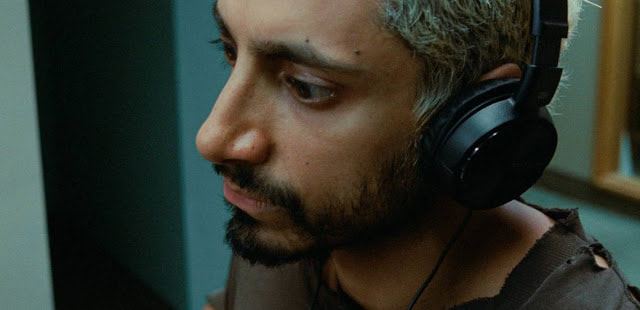
Picture: Riz Ahmed in
Photo: Amazon Studios
Director: Darius Marder
Starring: Riz Ahmed, Olivia Cooke & Paul Raci
Rated: R
Runtime: 2 hours 
​Director Darius Marder's “Sound of Metal” is both an eye-opening yet strangely calming experience. Co-written by Derek Cianfrance (“Blue Valentine,” “The Place Beyond the Pines”) the film has his trademark feel of being wholly inhabited by real people in authentic places with a visual aesthetic that reads just as pure as the subjects. Marder, who co-wrote ‘Pines’ with Cianfrance and had only directed a documentary prior to this, his debut narrative feature, lands on the perfect type of story to apply to this style. The story of Ruben (Riz Ahmed) is a very human, very grounded, and largely - a very cleansing one - but as presented through this veritable style of Marder and Cianfrance Ruben's tale takes on what feel like mythic qualities, turning it into more than just a story, but a parable. While not your traditional parable as told by Jesus in the Gospels, “Sound of Metal” is a more raw approach to that age old serenity prayer that people repeat to remind themselves of the influence they have over the occurrences in their life on earth. "God grant me the serenity to accept the things I cannot change, the courage to change the things I can, and the wisdom to know the difference." In “Sound of Metal,” Ruben comes face to face with a reality he can neither control nor accept. As a drummer for a two-piece metal band seemingly on the cusp of bigger and better things the sense of sound is one of the most critical aspects of Ruben's life. So, when the feedback becomes more consistent, the ringing doesn't stop even after a night's rest post-gig, and the frequency of other people's voices becomes so inaudible that everyone begins to sound like Charlie Brown's teacher he knows he can't ignore the issue and he knows it won't magically go away no matter how much he needs it to. Ruben runs headfirst into the question of how does one preserve the hearing they have left when they can’t preserve themselves without it? It would seem the only choice Ruben has is to accept this literally deafening blow and adjust the entirety of his life moving forward, but as is expected - this is not an easy thing to do; it's maddening even. It is in this frantic period of time where the unknown is the key player that Marder both finds the film’s tension as well as the gateway into exploring this thesis of dealing with change, adapting to that unknown and understanding that the cruelty of the world isn't picking on you, but challenging you to discover new ways of finding the beauty in it.    

The film opens by immediately indoctrinating the audience into the world Ruben loves as he sits behind his kit and plays along with Lou (Olivia Cooke) who takes care of guitar and vocals. Marder restrains the performance moments strictly to the stage limiting our knowledge of how big the venues are and therefore making Ruben and Lou's status as a band more ambiguous. The two are currently on a tour they've booked though, and as the film plays on we hear references to labels and see magazines with the two of them gracing the cover, so there's either much to look forward to or a past to recover. Either way, in their current state Ruben and Lou live together in an Airstream catered perfectly to their needs in between gigs. Marder takes us through a typical "day in the life" of Ruben displaying how he is an early riser, that he is conscious about his health as he exercises and makes nourishing if not necessarily the tastiest smoothies for, he and Lou. They've also converted a portion of the RV into a studio space so as to create new music while on the road, but neither go on with the rest of their day before dancing with the other to the sultry sounds of The Commodores. Marder uses this routine to not only establish the adorable and completely dependent relationship these two have with one another, but to also give insight into how much better Ruben is doing given the parts of his past we come to find out about later. Marder then also repeats certain shots to not only emphasize this is in fact a routine, but to then allow the viewer to experience those same, mundane morning rituals without sound as it's on one of these routine mornings that Ruben wakes up feeling as if he's been elevated 500 feet overnight and needs his ears to pop. After a consultation with a doctor and receiving a less than optimistic diagnosis Ruben is put in contact with a man who runs a program to help those in the deaf community. Joe (Paul Raci) is a Vietnam war vet who lost his hearing when a bomb went off near him and who pushed his friends and family away afterwards with his alcoholism. Lou knows Ruben needs to enter Joe's program, learn some sign language, and get a handle on this new development, but Ruben isn't focused on accepting his fate and adjusting his mind to compromise. No, Ruben wants to have cochlear implant surgery and return to normal as quick as possible. It's obvious this is a form of denial as Ahmed's performance assures us Ruben knows better and knows he's going to be forced to deal with this new way of life and thus the investment in him grows.
 
Curiously, while the middle section of the film is far and away the heart of the story what is glaring is the fact Lou is absent for all of it despite being Ruben's whole heart. While away at Joe's program, Ruben is only allowed to connect with Lou intermittently via e-mails while also following the band's social media buzz. Lou obviously has as checkered a past as Ruben and it's clear they both saved one another from themselves in some capacity, but just as with their careers the past is never stated explicitly. The news Ruben was once an addict is delivered pretty bluntly as suspicion is sewed early when Lou's first reaction to the news he's lost his hearing is to contact what appears to be his former sponsor who then puts them in contact with Joe. It is in the first meeting with Joe that he openly questions Ruben about his addictions and how long he's been clean. Not coincidentally, Ruben has been clean for four years which is the same amount of time he and Lou have been together. Lou has her own baggage, but we're not privy to the details of this until the third act when her wealthy father (Mathieu Amalric) volunteers details of their fractured family dynamic. While there is sound reasoning for the narrative choices made here the tragic nature of the outcome feels somewhat forced and rather as if it were the preferred choice to serve Marder and Cianfrance's tone instead of the character's desires. This is the single facet of the film that feels problematic especially given the aforementioned establishing scenes and more importantly, a goodbye scene in which both Rubin and Lou come to the unspoken agreement that neither want this, but know it's what's needed. What follows in the third act is a dissolution of the momentum they were carrying in their "little gypsy life" as Lou has seemingly matured as much as Ruben has grown - both realizing the world outside of one another may yet offer them the actual hope they were chasing after when they were together. It would be fascinating to garner the different audience reads on the conclusions the characters in “Sound of Metal” come to, especially Lou whose reaction seems to be that of a deep understanding that she and Ruben will never be able to recapture or go back to the lives they once had, but doesn't want to either accept it or disappoint Ruben. Equally, Ruben seems to finally give up on the fairy tale of endless travels and quirky conversations in favor of a larger picture, but this isn't easy for him. It's understandable as well given Lou was the first person that likely made Ruben feel worth a damn or that he had something to offer that could actually fulfill the life of another person, but it is through the aforementioned second act that Ruben learns, grows, and matures to the point where he is able to sit where he does in the film’s final shot.        

There’s a moment nearly an hour and a half into the film where a discussion takes place about life, the need to belong, and what it all means. It’s a moment that feels it's drifting in one direction, but is derailed by clashing ideologies about what are in fact the most important things in life and how as much needs to be obtained in order for this life to actually feel worthwhile. It is this moment, this culmination of Ruben's journey of sorts that bridges the gap between who Ruben was and who he could become. This journey is made indelible due largely in part to the performance of Ahmed who not only brings us into this journey of a man trying to find his way in a world that has taken everything from him, but the frustrations of it all as well. The sheer awareness of how much his facial expressions have to adjust from one end of the movie to the other, how critical these are to the audience grasping his devastation and confusion, and the control Ahmed exhibits in this regard is stunning. Upon first arriving at Joe's program and meeting others in the deaf community proves irritating not because the people are unbearable or rude or any such nuisance, but because Ruben doesn't want to accept that this is now his reality as well and who can blame him? Joe and his pupils don't view being deaf as a handicap or as something that needs to be fixed and Joe has to frequently remind them of as much in order to maintain a peace about his land. Naturally, this frustrates someone who feels that sitting back and accepting this fate is giving up while working to correct the issue is the only option, the ultimate goal. In large respect, it's not difficult to understand exactly why Ruben feels the way he does and at times it's even easier to side with our flawed hero even as the film positions him in the role of the naive apprentice not as well-versed in the paradigms life will continue to confront him with. Ironically, what provides Ruben with a glimmer of hope in this life that almost certainly won't work out the way he expected are the deaf elementary school kids that he becomes something of an older brother to; they ultimately teaching him more than he does them despite the unbalanced ratio of life experience. Ruben's integration with the adult community around him is crucial in his development as well with Raci leaving the biggest impression as he truly delivers a powerhouse performance. 
 
Adding Nicolas Becker's sound design to the mix highlights another element just as critical to the film as Ahmed's performance as it wholly transports the audience to this mindset of moving between these worlds of sound and complete silence. We go from being able to hear clearly to the muffled and distorted sounds akin to having water in your ear that emphasizes how close yet how out of reach that pure, unfiltered sound is. Again, devastating. Becker's choices about when to utilize traditional sound as opposed to placing Ruben's ears in our own are perfectly balanced. These choices give way to the conflicted pull Ruben is going through internally while freeing us from hardships of constantly navigating Ruben's path so as not to create a maddening experience, but a sympathetic one. The film has also been subtitled so it can be experienced by both the hearing and deaf communities. Becker's sound paired with Marder's penchant to add directorial flourishes such as intermittent shots of nature, from clouds moving overhead to trees swaying in the wind, that initially seem lazy and little more than a bullet point leftover from Film School 101 are repeated enough to realize that Marder isn't just minding the pacing of his deliberate character study, but illustrating the lengths of sound in our everyday life and how much we take it for granted. Sounds accompany the slightest movements. Even in what we believe is silence there's still a comforting hum or background noise that keeps a consistent frequency and to imagine how much this unacknowledged constant would be missed were it suddenly stripped away is what Marder is slyly alerting his audience to. Within this, Marder also emphasizes the idea that music is a language no matter how you feel it and it's this newfound conviction, optimism, hope - whatever one wants to call it - that instills an ambition Ruben will find a place he feels he belongs; whether in silence or not. 
 
“Sound of Metal” begins streaming on Amazon Prime Video on December 4.
0 Comments


Leave a Reply.

    Archives

    December 2025
    November 2025
    October 2025
    September 2025
    August 2025
    July 2025
    June 2025
    May 2025
    April 2025
    March 2025
    February 2025
    January 2025
    December 2024
    November 2024
    October 2024
    September 2024
    August 2024
    July 2024
    June 2024
    May 2024
    April 2024
    March 2024
    February 2024
    January 2024
    December 2023
    November 2023
    October 2023
    September 2023
    August 2023
    July 2023
    June 2023
    May 2023
    April 2023
    March 2023
    February 2023
    January 2023
    December 2022
    November 2022
    October 2022
    September 2022
    August 2022
    July 2022
    June 2022
    March 2022
    February 2022
    January 2022
    December 2021
    November 2021
    October 2021
    September 2021
    August 2021
    July 2021
    June 2021
    April 2021
    March 2021
    February 2021
    January 2021
    December 2020
    November 2020
    October 2020
    September 2020
    August 2020
    July 2020
    June 2020
    May 2020
    April 2020
    March 2020
    February 2020
    January 2020
    December 2019
    November 2019
    October 2019
    September 2019
    August 2019
    July 2019
    June 2019
    May 2019
    April 2019
    March 2019
    February 2019
    January 2019
    December 2018
    November 2018
    October 2018
    September 2018
    August 2018
    July 2018
    June 2018
    May 2018
    April 2018
    March 2018
    February 2018
    January 2018
    December 2017
    November 2017
    October 2017
    September 2017
    August 2017
    July 2017
    June 2017
    May 2017
    April 2017
    March 2017
    February 2017
    January 2017
    December 2016
    November 2016
    October 2016
    September 2016
    August 2016
    July 2016
    June 2016
    May 2016
    April 2016
    March 2016
    February 2016
    January 2016
    December 2015
    November 2015
    October 2015
    September 2015
    August 2015
    July 2015
    June 2015
    May 2015
    April 2015
    March 2015
    February 2015
    January 2015
    December 2014
    August 2014
    July 2014
    June 2014
    May 2014
    April 2014
    March 2014
    February 2014
    January 2014
    October 2013
    August 2013
    December 2012
    September 2012
    August 2012
    July 2012
    April 2012
    March 2012
    February 2012
    January 2012


​
Proudly powered by Weebly
  • Home
  • Movies
  • TV
  • Music
  • Sports
  • Pop Culture History
  • Shop