 by Philip Price
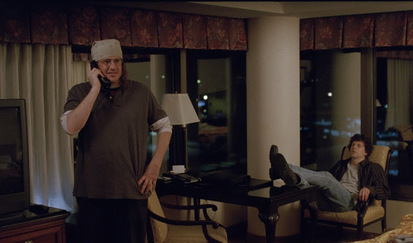
In the first frame of “The End of the Tour,” the new film from director James Ponsoldt, we glimpse Jesse Eisenberg's David Lipsky sitting on a couch with his laptop and his dog. It is a simple setting, one we don't think much of upon initially seeing. In fact, if you know anything about the film prior to seeing it you know Eisenberg's character is a writer and therefore this setting is somewhat expected. As we better acquaint ourselves with David Lipsky over the next hour and 45 minutes though, we learn more about him, about his time with author David Foster Wallace (played here by Jason Segel) and that first frame becomes all the more telling. “The End of the Tour” is, on the surface, a road movie about one writer doing a profile on another writer, but more than that it is a film of conversation and constant introspection. It's almost exhausting to constantly think in the way our two main characters presented here do, throwing out ideas and immediately reassessing those ideas or deep-diving further to find the root of where such ideas come from. The talking — it can be a bit much, it can feel overbearing even, but it ultimately captures so much of the soul that it can't help but feel soothing at the same time. It's strange, to be sure, but it makes perfect sense, especially when it's so elegantly and perfectly phrased in Wallace speak. Wallace speaks a lot in this film iteration of Lipsky's book, Although of Course You End Up Becoming Yourself, that was published two years after Wallace committed suicide. While much of the dialogue feels like a culmination of Wallace's philosophy or his verbal dissertation on the complex and mundane aspects of life and how they're one in the same it somehow manages to also be a genuine portrait of a conflicted mind. It should be noted up front that Wallace's trust has come out against ‘Tour’ outright, but regardless of what is accurate and what is not (this is a movie, after all) “The End of the Tour” is still an insightful portrait not only of the male mind, but of the messiness of life and all the bullshit one has to sift through in order to even catch a glimpse of something real. What strikes me immediately as being the most interesting aspect of “The End of the Tour” is the way in which it never lags. This may seem like a rather basic observation considering the amount of topics discussed and the depth of the conversation that takes place in the film, but the fact the majority of the runtime is made up purely of conversation and it never lags is fascinating to this millennial who naturally needs explosions and spandex to stay intrigued. I'm exaggerating of course, but it does take a certain level of conversation, of words put together in a specific order to articulate interesting and compelling thoughts that allow them to be able to sustain a feature length film and Pulitzer-winning playwright Donald Margulies pulls this off with seeming ease. Of course, I doubt the writing and compiling of Lipsky's interview and subsequent book combined with shaping them into a coherent narrative was anything but easy, but the finished product allows it to feel that way and that says a lot for the people who endeavored to try and pull this off. The process of writing is one that appears to be unique as far as approach goes for each individual, but once your ass is in the seat and your fingers are to the keys it is a process of discovery as you propel yourself further into your own thoughts. Having to write about another writer (not to mention two) and the way their brain works is a task that sounds interesting, certainly, but is one I don't know you'd necessarily define as enviable. It would be more than easy to become muddled and weighed down by the numerous avenues one could take and in attempting to streamline such complex thoughts and people you are undoubtedly doing an injustice to the actual human being. With that burden in mind, Margulies has seemingly stared down the barrel of a week's worth of prose and fashioned it into something that, if not actual representations of these people, are at least symbolic interpretations. While it is the ability of the dialogue to sustain a constant intrigue, it is obviously the performances conveying this dialogue that do the majority of the heavy lifting. Made up of mainly Segel and Eisenberg going back and forth, the film’s success hinges on their chemistry with only brief interludes from Mamie Gummer and Mickey Sumner playing friends of Wallace's who live in Minnesota and who the pair hang out with on their tour of the twin cities. There are flashes of Joan Cusack's comic genius as a Minneapolis escort that plays to the end of the spectrum in which our two David's typically find pleasure in deconstructing and dismissing. Cusack's Patty is as conventional and absent-minded as the two academics she's driving around likely suspect any average American to be, but I bring this up because it is the commonality that corporate America presents as normalcy in which both the movie and the minds of our leads find their humor. Segel's Wallace doesn't so much convey the narcissistic pretension that drips off Eisenberg's Lipsky (though this is only because Wallace is a proven writer while Lipsky is still working for acclaim) though it's clear Lipsky only presents this facade as a way to cover his own insecurities, especially around someone as imposing as Wallace. It isn't even that Segel's Wallace discounts much of what we see as good, seductive commercial entertainment for the sake of feeling better than everyone else, but more because he seems to feel sorry for us. Is this where we find satisfaction? Is this what it's come to? The idea of self-reflection and the awareness of one's self is the theme that seems to resonate most though. Segel's Wallace is in a state of constantly discussing this thousand page tome that he is not only still wrestling with the questions and content of it, but he is already disenchanted with the process of having to deal with the attention that comes along with doing an otherwise lonely job. That Wallace can see Eisenberg's Lipsky is just on the other side of this wall, craving all that he has in terms of success and attention for his writing (only amplified by Lipsky's inclination to imitate him) he can't help but to think of Lipsky as something of a stupid, ignorant kid. It is petty jealousy in all actuality, but it propels the dynamic of our two characters forward in a fashion that keeps tension bubbling right below the surface while the ultimate goal remains the two trying to figure out if they even like one another. That isn't to say Wallace is a complete downer who wallows in his admitted depression the entire time either. The two writers we are privy to listening in on admit to the greatness of the original “Die Hard,” they go see Broken Arrow at The Mall of America and Wallace has only a poster of Alanis Morisette on his otherwise empty walls because she feels more attainable than most pop stars. Wallace also consumes packs of diet sodas and pop tarts throughout the film making someone who is typically glorified as some kind of deity into a more accessible commoner because of the familiarity of his habits. Of course, that is what Wallace would like his fans and anyone else who's even just heard his name to think about him, but Lipsky is sure there is more to the man even if Wallace genuinely doesn't believe so. Lipsky, as played by Esienberg, is more what we expect from a writer who is in a position where it feels inevitable he might one day accomplish his dreams due to his persistent hard work, but is inevitably irritated by the success of someone like Wallace because of its effortless-like nature. Wallace is a natural academic/genius of sorts and that he has been able to accomplish all he has at his age gives Lipsky the impression he only has so much more time to attain his goals. Intentional or not, Eisenberg's Lipsky begins to emulate Wallace halfway through the film and its clear Segel's Wallace takes note. This small detail is acknowledged, but not discussed or drawn out as a major point of drama. More, the moments of observation are meant to give us further insight into these characters than even the introverted dialogue suggests. As much as Wallace and Lipsky talk about how one can never win within the vicious circle of our commercialized society that purports the ongoing battle of credibility and popularity or how intimate they get when discussing relationships, it is never as telling as the looks they cross at one another and for that, the performances deserve a mark of being rather incredible. For Segel, this is a performance that separates him from the pre-conceived notions of him strictly starring in comedies or being the "Muppets" guy. This is seemingly a character Segel will be unable to walk away from for a long time to come. Like Johnny Cash for Joaquin Phoenix or Andy Kaufman for Jim Carrey, one can see the idea of who this real-life person was integrating itself into the actors psyche as their performance plays out on screen. Even watching interviews with Segel as he discusses the film it is rather clear it will take him years to come to terms with the ideas this deep dive brought to the surface. While this type of role is certainly a unique opportunity for the actor and life-altering to some degree, when it is boiled down to what we're actually given in the final product Segel presents just the right amount of majestic mannerisms to make one wince and smile while being sincerely funny and intelligent without being aggressively so on either front. The real David Foster Wallace may not have been one who would care to see himself on a movie screen, but despite the claims of the film being inaccurate, I can't imagine anyone not at least appreciating the effort and earnestness with which Segel portrays this human being if, for nothing else, the fact it will bring more people around to the works of Wallace. “The End of the Tour” is art about art. It is about being able to articulate your inner-monologues in ways that bring others to you, to acknowledge that what you've put down on paper is relatable and worth something to others as well. The film does this to great accomplishment, hitting on moments, interactions and thoughts that will inevitably ring true to a wide array of viewers. It takes a deeply confident and introspective person to not only sit down and dedicate the time it takes to write a novel, but to think that random people will think enough of one's ideas to take time out of their own day to read it. Wallace has a quote in the film about his introverted personality and how he thinks being shy basically means being, "self-absorbed to the point that it makes it difficult to be around other people." While the film finds pride in conveying universal thoughts in artistic ways this quote exemplifies why it is scary to actually release thoughts and scribbles out into the world for others to share in for the reticent person. If writing a work such as “Infinite Jest,” that ultimately connects on multiple levels with many people, is one of the loneliest experiences a person can have but is done more for the sake of getting these thoughts off one's chest than actually connecting with others why would Wallace want to bother with how it's received? Why would someone who is inherently shy risk such probable interaction not to mention creating a persona they could never actually live up to even if spectators buy into the act? Not only is this disposition a lonely way of thinking, but it often times results in an equally lonely existence save for the person who doesn't have an agenda of their own and whom you can share everything with. Oh, if it were as easy to find the person as it is to describe them this world might be a kinder place. As it is, and as “The End of the Tour” reminds us, the great irony of constantly striving to better understand human interaction, ways of thinking and the basic utilities that create our "satisfactory" lives is that this work typically ends up limiting such interaction. That life is what happens when you're busy contemplating it which only makes that opening shot as telling as ever when we come back around to it.
0 Comments
Leave a Reply. |