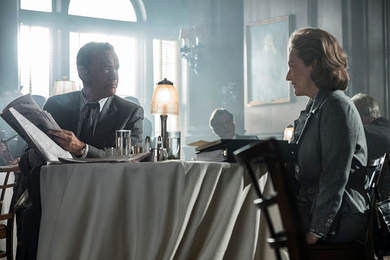
 by Philip Price
“The Post” is as much a movie as it is a strict documentation of a sequence of events that deal in something as fleeting as time and the importance man places upon the construct of time. Time, by all definitions, is a mental construct used to make sense of movement. There is a great sense of the collusion between time and movement in the latest from director Steven Spielberg and how what man has created to help maintain order can also spin us into the very midst of confusion as chaos is so often categorized. Simply by defining how long something has the potential to be powerful or life-changing we set ourselves up for large successes or failures. It is no surprise then that Spielberg focuses not on the passage of time or how this fleeting thing called life is formed against the backdrop of the time we just so happen to have been born into or exist within, but rather how time is what we do with it. What defines our lives and the time we can spend on this earth is not simply how we make it through one day to get to the next, but by the actions we take, the strides we make, and the deadlines we set for ourselves and either meet or don't. It's a thesis based on the hope that nobility is a prized possession in any viewer that sits down to take in history as told by the movies. This thesis of sorts is meant to both stir something deep within for the pride in one's country that allows for, "the press to serve the governed, not the governors," while at the same time utilizing this message to remind us all that history undoubtedly repeats itself. One would be remiss to go through a full discussion around “The Post” without mentioning its relevancy, but more so-its poignancy-in relation to the present state of the world and the leaders that are in power; utilizing their power for personal gain and favorable poll numbers rather than in the interest of world peace. Our present day is not the world the characters in “The Post” thought they were shaping or being bold enough to attempt to usher society into and while Spielberg makes no direct indication of his intent the opportunistic quality of the project is enough to suggest as much. It would be futile to not mention such obvious parallels and why this film feels more like a product of today despite taking place 46 years ago. This isn't a negative in terms of how it plays throughout the narrative either, but is more a return to this idea of time, time as a construct, and how it isn't a neat and tidy sequence of events one can always apply a narrative to, but something that is forever reminding us, humans, what we must do and what values we must continue to uphold to ensure our continued survival. “The Post” may not exactly be a revelatory piece of work, but it is certainly a direct and not so gentle reminder there has to be examples of the best of us in the worst of times. Beginning in Vietnam in 1966 we are introduced to Ellsberg (Matthew Rhys), an observer from the American Embassy who is taking notes on the progress and effectiveness or lack thereof of the United States military being present in Vietnam. An encounter with Secretary of Defense Robert McNamara (Bruce Greenwood) makes it obvious to Ellsberg that no matter the truth of the situation or even the belief in that truth behind the scenes, there is nothing more important than saving face and keeping the peace in Washington, leading Ellsberg to steal sensitive government documents that were meant to be historical surveys of America's involvement in the Vietnam war and share the truth with the world. Jumping to Washington DC, in 1971, we are then introduced to Meryl Streep's Kay Graham, the woman who inherited The Washington Post from her husband after his suicide when she was 45, who had in fact inherited the paper from Graham's father prior to his passing. Graham has now found herself in a position she never thought she'd be in where she is not only having to manage the output of the paper and her pit-bull of an editor in Ben Bradlee (Tom Hanks), but also the negotiations with bankers to take the newspaper public to make the company solvent, to stay in business, and to be allowed to continue to grow. It is in this kind of dual responsibility that screenwriters Josh Singer (“Spotlight”) and Liz Hannah (“Hitchcock/Truffaut”) track the narrative as the film follows the developing situation of each as they both come to play greatly into the significance of the other. While Graham consults with Fritz Beebe (Tracy Letts) and is nervous given her resolve for turning a profit is in question with the board she is also put in another awkward position when the New York Times runs a story about her good friend McNamara concerning the fact he was aware a classified department of defense study he commissioned was leaked and published, essentially telling the world the government had given up on Vietnam several years before it was over while still sending troops to be slaughtered. While this strand in the storytelling largely deals in Bradlee and his team, including Ben Bagdikian (Bob Odenkirk), Howard Simons (David Cross), and Meg Greenfield (Carrie Coon), chasing down the remaining Pentagon papers dealing in these Vietnam affairs after the U.S. attorney general specifically requests The Times refrain from further publication of these documents. Bradlee is pushing to publish the remainder of these papers so as to take The Post from the smaller operation it was regarded as at the time onto the national stage while also staying true to his conscious and convictions despite many board members, including Bradley Whitford's Arthur Parsons, trying to steer Graham and her paper in a direction she isn't actually interested in. As much as “The Post” is about this tense period of time in the early seventies just prior to the Watergate scandal it is also a film that works in the necessary angle of being about a woman in a position of power during a time when such female figureheads weren't common and more so, weren't trusted to be able to handle the demands of such high-profile jobs. Late in the film, Streep's Graham is having a discussion with her daughter, Lally (Alison Brie) who would come to serve as a senior editor of “The Post,” where she asks her if she's ever heard the saying, "A woman preaching is like a dog walking on its hind legs-it's not done well, and you're surprised to see it's done at all." Graham goes on to tell her daughter, who is clearly disgusted at the thought of such degenerative speech being spewed in her or her mother's direction, this was simply the way they all thought back then. And so, while Spielberg is very clearly hoping to draw some parallels in terms of political climate, he is also interested in making a strong case for the equality of women in the workplace and in all walks of life. There are several sequences in the film where we see Streep's character walking into large, crowded rooms where it is immediately apparent that she is one of the few if not the only woman in the room. Spielberg does this to intentionally build and remind the audience of the overwhelming atmosphere of pressure that women such as Graham and likely to a larger degree for women not in a position of power such as Graham had to deal with on a day to day basis. And though Graham does a fair amount of hosting parties and entertaining guests throughout the film, what is more of note are the scenes in which Streep is asked not to command a room or ease those nervous to be in her company, but those of the scenes where she is tasked with making difficult decisions. This may sound like a specific instance or a scene, but there are more than a few instances where we see the typically well-spoken Streep play Graham as a woman who may in fact be out of her depth, but can't allow the public to derive as much-putting up a united front to make bigger strides in the broader scope of the world. These scenes where Streep is given little dialogue and is on the phone with multiple people, but where Spielberg chooses to keep his camera on her for most of the sequence are telling in the way Streep's face conveys everything we need to know about the countless thoughts rushing through her mind and the trepidations she must have felt being asked to risk all that she'd recently inherited for nothing more than what she believed was right. While not featured heavily, the great Sarah Paulson has a scene as the wife of Hanks' Bradlee, Tony, where she presents a moment that lends the film and Bradlee a different perspective than he might have considered prior. A perspective Spielberg is keen on making an integral part of the narrative in “The Post.” That said, there are also plenty of other themes, ideas, gestures, and/or thoughts that Spielberg's latest wants to contemplate and consider whether it be in having an administration dictating news coverage just because they don't like what these publications have to say, how these said publications need to be the check for those who don't believe they should be held accountable for their actions, or the fact that the President of the United States genuinely believes that if he can't keep secrets, he can't govern properly. Sure, this might be true to a degree and I'm not one to live in a fantasy world of absolutes, but in the instance of “The Post” Spielberg and the screenwriters make the case the governing body at the time knew the U.S. couldn't win the war and yet they still sent boys to die and did this largely to avoid the humiliation of an American defeat. To this degree, Spielberg does make attempts at showing both sides of the story as he portrays those who leak the documents as well as the ensemble of journalists as people with both strong consciousness and convictions, but also a fair amount of ego that is not to be cast aside. Such themes go back to that idea of the film's thesis being based on the hope that nobility is a prized possession in the viewers as Graham reiterates time and time again that her newspaper is dedicated to the welfare of the nation and to the principles of a free press; admiring the saying her father used to speak that taught her, "the news is the first draft of history." These ideas are implemented cleanly and successfully by both Spielberg in his capturing of the necessary emotions and by the screenwriters who have somehow managed to turn this, what was no doubt a sprawling epic of personal accounts, an abundance of small details, and more characters than one could ever give their due diligence to, into a streamlined, efficient, and never tedious film that is effective in its objective while still coming in under two hours. The film just continues to move; never slowing down and never stopping to make sure the audience is keeping up. Rather, Hanks and Streep deliver performances we've come to expect (and now probably take for granted) from the powerhouses that they are whereas the supporting cast stands out mostly in scenes where Odenkirk is sent on a mission to recover the papers that might allow Graham's "little local paper" to break the big story wide open. Brie also holds her own in scenes with Streep as the two communicate a genuine, but unique mother/daughter relationship that is never given the necessary time to be established or developed, but the two actresses are still able to help us understand the dynamic with ease after the first conversation they share on screen. The likes of Jesse Plemons and Zach Woods also show up as lawyers on the payroll of “The Post” to help guide the staff in their efforts to publish a story around these leaked documents that inadvertently causes a fair amount of tension. While not all are given much to do, Whitford's Parsons is especially one-note, the cast all bring a sense of gravitas to the project. That said, “The Post” is a film that is informative if not necessarily as moving as you might expect. An exercise in expert filmmaking by a director who has so honed his craft by this point it would seem Spielberg could make something such as “The Post” in his sleep. And maybe he could, maybe “The Post” isn’t something that is necessarily great, but this isn't because it's not breaking any boundaries, but more because it stands to say so much and does so in as efficient a manner as one can imagine without becoming complicated, beleaguered, or overlong. This seems to give some pause to the fact something as layered and complex could come across so easy. Something like “The Post” shouldn’t feel as if it were easy to pull off and yet, that is the impression Spielberg’s film gives by the time we reach the films multiple endings that see it concluding with a tease that would suggest a historical universe of movies a la Marvel were coming down the pipeline. I kid, but I wouldn't mind. Inevitably, “The Post” is a brisk, but weighted slice of cinematic heaven. There is a sequence late in the film that chronicles the assembly of the next morning's edition that is truly fascinating in that it shows how much things have changed as well as how much work was required to make a deadline in those heydays of print. Much like the paper itself, on the surface “The Post” seems a well-oiled machine of determination and ink that Spielberg guides to effectively stirring results while only hinting at the numerous and equally interesting stories that might lie within the story we've just seen (or read).
0 Comments
Leave a Reply. |